Wednesday, July 17, 2013

Thrift Store Math Game!


I am getting married in December and I have been stopping by Thrift Stores looking for glassware for the centerpieces.  Every time I go, I feel compelled to look through the games in hopes of finding something cool to repurpose in my classroom.   (I saw this cool idea on pinterest for a make ten game—but haven’t found those materials yet!)

Last night we went to a store in Salt Lake and I happened upon an old BINGO spinner cage.  Instantly I thought “random number generator”.  I looked at the price tag (a steal at $0.75!) and knew I just found a new game for my classroom.

I took it home, cleaned it up a bit and emptied the numbers.  First, I checked to see what numbers were included (being a second and set, and not knowing what numbers a BINGO set includes). I laid them out on a hundred board.  The set has a few missing, but overall it is in great shape!
 
 
Here are the supplies:


The game will be played like this:
Each player will have a hundred board and crayon.  They will spin the cage and get a number.  They will color it, put the number in a cup, and spin for another number.


 (Sorry, this picture refuses to rotate!)
 

Later in the year, I will give them a cube that says “one more”, “one less”, “ten more”. “ten less” on it.  they will roll that before they get a number and color the appropriate answer in.
 
Happy Wednesday!

Sarah

Wednesday, July 10, 2013

Summer Survival Kit

I am a little late in sharing, but better late than never!

Right before the end of the school year, I was surfing the web for research on summer learning loss.  I came upon the National Summer Learning Association (http://www.summerlearning.org/ )

What did I learn?

 Our kids are at an extremely high risk of losing a good portion of what we worked so hard for them to learn during the school year!

 The statistics are alarming.

 
So that started me thinking… what can I do about it?

 
Every time we have a break from school (Thanksgiving, Winter, Spring) I always send home some kind of “challenge packet” with a reading and math component.  They are completely optional. The students are rewarded based on what they do (so if they only do the math, they only get a prize for the math part, and so on).

 
But summer is SO much longer… and, obviously SO much more critical!

 I decided my students needed a “Summer Survival Kit”! 

 
I wanted to make it fun, so I started with this label:

 On the back, I wrote a little letter to my students:


Then I included an information page for the parents to know the WHY behind this. (After all, I am not putting all of these together because I have nothing better to do—I am doing this because I care about our kids!)

On the back of that page, I included a calendar for the kids to track their summer:


This was added because my little sister has dedicated her life to child hunger.   She has developed a Summer Feeding Program in Seattle, so when I told her about my “Summer Survival Kits”, she really encouraged me to include this- it is for our local Free Summer Meal Sites for kids.


I put this handwriting book in because handwriting (and other fine motor skills) was so bad this year—any practice will be good for them!


A Summer Journal- just a little one (only 10 pages) for them to write about fun adventures that they have this summer, books they read or even adventures they wish they had.


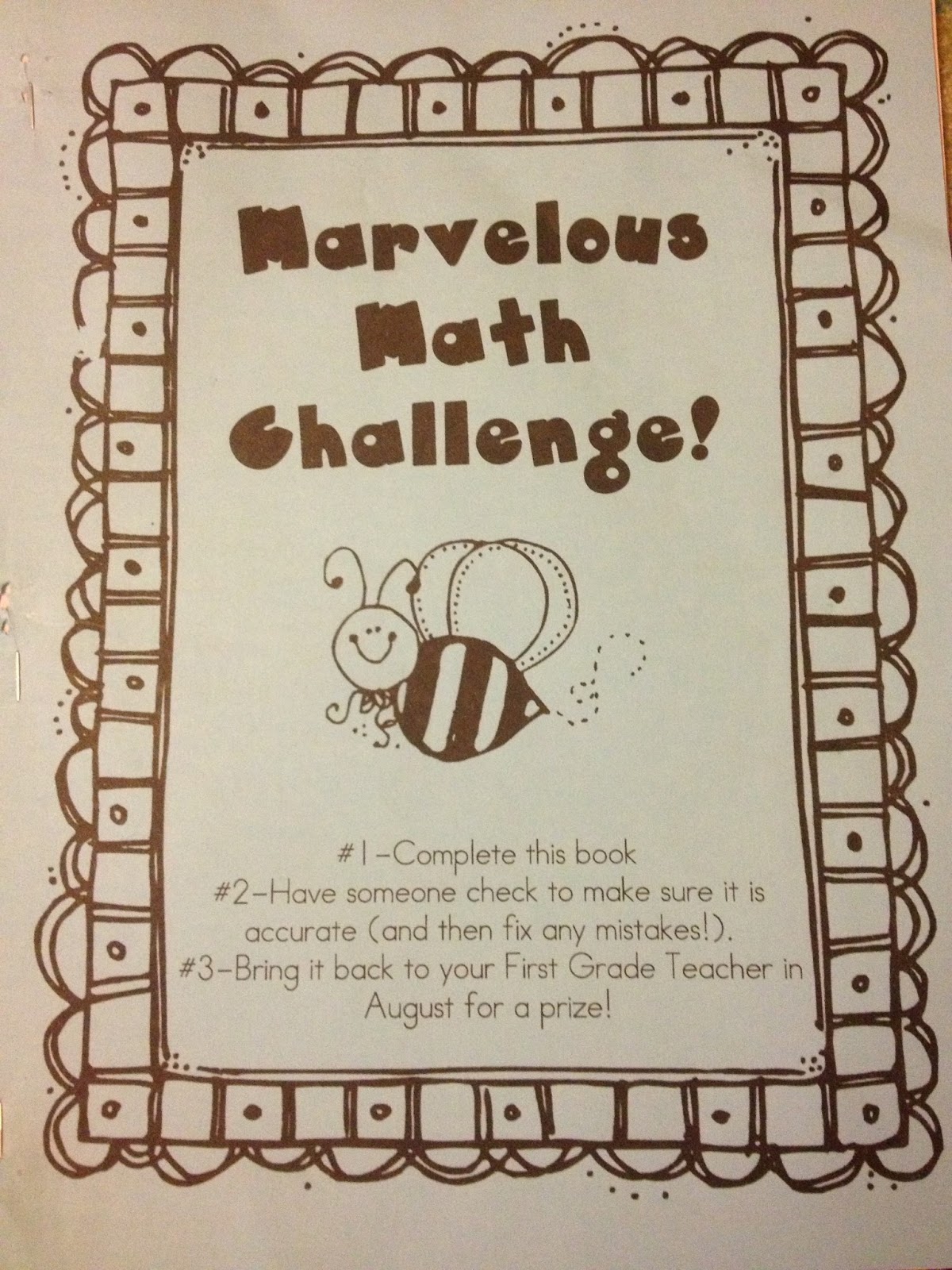
Marvelous Math Challenge!

This is just an assortment of math review pages (actually many of them are things that were good practice but I never had a chance to use—yay for finding a good use of extra copies!)


2 pencils and a few treats


Just for fun, I threw in a magazine (one of the sample magazines that I am sent all year long—I collect them over the year, we use them in our class library but then I send them home for the summer rather than storing them.)  Some students got Highlights Magazine, some got National Geographic Young Explorers.


 Here it is- all put together!
(I put it in a gallon ziplock bag-- next year I want to find a more fun bag for it) :)


I gave it to them like a present- calling them up individually.  It was really fun and they were SO excited!

Tuesday, June 18, 2013

First Graders are AMAZING! (And my persepctive on the Common Core Standards in Math)


Hello, Friends!
There has been so much discussion about if the Common Core (or, as our legislators in Utah prefer to have it called “Utah’s Core Standards”).  Are they developmentally appropriate?  Are we expecting too much of our students?
I understand that if you are the parent of a third, fourth, fifth or sixth grade student, I can easily understand why you are frustrated and concerned.  I have no doubt that math is a source of stress for your child right now. It is likely that your child comes home with homework hat you don’t understand. (I can tell you that many of my first grade parents didn’t understand the homework that was coming home last year- not because they don’t understand math, but because they are not accustomed to thinking about numbers as fluidly as the new Core Standards require.)
Here’s the thing… we know that American students are achieving below students in other countries.  We know that our kids are equally capable.  We also know that we have amazing teachers here. (Have you seen Pinterest lately? Our teachers are AMAZING!)  So we need to do something to help our kids reach their potential.

What’s the alternative? Continue at the rate we are going—where our teachers are working hard and our kids are learning- but are not completive in the world market?  Continue waiting for the rest of the world to slow down to our speed?  Sorry, but I don’t want to play that game.
So how do we get our kids on the right track?  We could, I suppose, start with the preschoolers.  Start them out on the right path and go from there.  That’s great—for those kids.  But what about the children already in our schools?  How can we possibly say “We know that there is a better outcome for you, but it’s too late for you—sorry.”  I don’t think I could sleep at night feeling that way.
So we have to do the best we can to bring ALL children up to speed.  There will be a learning curve.  And each year, I sincerely hope, it will get easier.  We have to hang in there.  Together we have to help our kids work towards a brighter tomorrow.  It’s not going to be easy, but I firmly believe that it will be worth it!!

I have a few examples from my own first grade classroom that were excellent reinforcement for my own commitment to the Common Core Math Standards.  I am going to share them here—please contact me if you have any questions, or if you have any great examples, I would love to see them!!
 
This student was responding to a task question. She showed her thinking by drawing it, writing an equation, and drawing a number line.
 
 
This is in response to a task. They had to show their thinking. This student drew pictures and then also showed her thinking by drawing a number line.
 
 
This is one of hundreds of examples I could give that shows how fluidly my students understood numbers.  You have to admit that it is pretty awesome.

 
When we were adding 3 numbers, this boy noticed that 4 and 6 make 10, labeled it, and then knew to add 5 more.


Happy Tuesday!
Sarah

Introducing Place Value

Every early childhood teacher can tell you that teaching place value is tricky.  It is an extremely abstract concept and some children will go with it, while others struggle to grasp the idea.  Every middle and upper grade teacher will tell you that place value is a critical concept- it is the foundation of our number sense. 
 
These are some activities I do to help my students build a strong understanding of place value.  
 
On the first day, before my students come in, I break apart unifix cubes into a tub.  Depending on the group size, I put in 80-120 cubes. 
I have my students work together to count them.  (Some groups will immediately start grouping them by color… others will just try and count them one by one… we discuss different strategies as they go.  Once we have a group that groups them by colors, and then by tens, I make a big deal about that strategy and the other groups give it a try.)


With this activity, they figure out that you can be much more efficient by grouping objects into tens to count how many.  That's the first step!
 The next day, I give my kids bags (and boxes) of assorted items to count…  I basically raid my manipulatives shelves and just pass them out.  We do the same kind of thing as the day before—they group the items into tens to find out how many. The difference is that they will not end up with exact groups (and they do it independently).  This allows for more conversations about tens and ones. (Again, be sure to stop and discuss strategies as you go… start with the most basic and work your way to the more complex.)


 They take the items, group them in to sets of ten and count them.


Then we move to a more pictorial version. I have laminated cards that have an assortment of stickers on them.  I have my students use a whiteboard marker to circle groups of ten.  They find the total (how many groups of ten, how many ones, how many in all), come and tell me, and trade for a new card.   It makes a great center after you’ve done it whole group!

(They look like this-- with a variety of stickers and a random mix of numbers).


Whenever introducing a math concept, remember that you must move from concrete to pictorial to abstract. Kids need to touch and feel to understand.