Sunday, May 11, 2014

First Grade Close Reading: Using a Decodable Reader

Close Reading...
Oh my goodness. I'm not sure I can adequately express my excitement for doing Close Reading with my firsties. They totally are capable of handling the higher cognitive demand.  They LOVE it.  And it will help them become better thinkers! 


Since it is so close to the end of the year, we shifted our focus from using a text that I read to them to  using a text that they can read (shared reading).  The best resource we have for that is our reproducible decodables that go along with our Basal reading program.  Obviously they are copyrighted, so I am sharing just a few examples of how we used them, but I can't share the decodable itself.   However, I am confident that you can find a resource that you can use in a similar way.  (We use McGraw Hill's Imagine It!)


We mapped out all of the things we wanted to focus on.  As we did it, we found that it went much faster than expected.  So, for me, I just had everything ready and if we found an extra 10 minutes in our day, we would pull out our books and do the next activity. It still lasted us all week.

We color-coded everything so that the kids could color-code the marks in their books.  For example, characters are blue, setting is purple, problem is red, solution is blue and for vocabulary, we used orange.

Since the purpose of a Close Read is to look more deeply at the text, we used our colors to circle/ show evidence from the text.  


Here are a few things that I had ready to help keep us organized. (The signs are also color-coded).


(We also had one for setting but it was super blurry...)
 
 
What kinds of things are you trying with Close Reading??
 
Happy Mother's Day!
Sarah

Saturday, March 29, 2014

BUILD-- week by week... March

I knew it was an ambitious goal.
And usually ambitious goals motivate me because I love a challenge!
But between getting married and some unexpected medical "fun", I have slacked off.
Sooo sorry!
But I remembered to take photos last week... so here you go!

B- Buddy Games
 For Buddy Games this week, my kids practiced "composing a ten".  They roll the dice, take that many ones. Then their partner rolls the dice, takes that many ones.  (Back and forth until they have ten or more.) When they have 10, the swap their ones for a ten rod.  Then keep playing! 

For my advanced kiddos, I have them play backwards. It is quite a challenge-- perfect for my gifted first graders!


You can download this game here.  (Remember to leave a comment if you download it!!) :)

U- Using Manipulatives

We will begin our plane shapes unit soon-- so I put inn some pattern block cards for my kids to use.  They love them and they differentiated-- so students can chose their own level of difficulty!

I- Independent Reading
 

As we are finishing up our measurement unit, we are enjoying some books about all kinds of measurement-- length and time.  They LOVE these books!

L- Learning about Numbers


This is their L activity for the week... just a simple color by the code activity. On the back there are some additional problems for if they have time.   

D- Doing Math 
These pages come from our math program.  They have been awesome because my kids are getting really fluent with their addition problems and have now moved on to subtraction problems.  I am not a huge fan of workbooks, but let's be honest. Our kids need to be able to answer a set of math facts. 
 
 
Hope this gives you some ideas!!
Sarah
 

Friday, March 28, 2014

Winner's Never Quit- by Mia Hamm

My team and I  have been working hard to develop Close Reads on one story in each unit.  This past month we wrote a Close Read for Winners Never Quit by Mia Hamm. 

If you haven't read this book, you should.  Mia (the main character in the story) has to learn a very first grade lesson-- that you can't always win. 

If you want more info on Close Reading, check out the Utah State Office of Education resources from Core Academy.

We structured our Close Read like this:

Day 1-
Read the entire story.  (I like to tell my kids that we can't stop when we are doing a close read because we want to hear the story exactly the way the author thinks we should... so that means no questions or comments until the end!) They LOVE it!
Then we do a retell. I write it on sticky notes-- that way we can sequence them on another day.


The next day we read the story again.
Then we discussed Characters. 
We wrote (on a different color of sticky note) all of the characters we could think of. Then we asked ourselves "Would this story still make sense if this person wasn't there?" If the answer is "yes" then they are not a main character.  If the answer is "no" then they are. :) We sorted them and then wrote adjectives for each character-- always looking for evidence from the text and pictures.

Then we looked at setting.  It is important to ask them "What evidence in the text tells you where this story is taking place?" we made a list (on a different color or sticky, of course!).  Then we discussed what that evidence helps us conclude.  This was my favorite discussion! They were so engaged!

 
After we have figured out the setting, we are ready to tackle problem/solution.  We discussed it and then I had my kids complete this story mountain, courtesy of USOE Core Academy.  My kids understood it SOOO much better than I thought they would-- it was very natural to them :)

We then focus on vocabulary. We want them to define the words-- USING evidence from the text. (Am I sounding like a broken record?  Am I sounding like the SAGE assessment?!) :)


  As a class we added thought and talking bubbles to our book.  They were so cute in thinking of what to say!


 Then I gave them pictures to add thought and talking bubbles to.  They had to write HOW they knew that is what was being said/thought.  (Sorry, that's not in the pictures!)


The final writing project was for them to write two reasons why it was okay for Mia to lose and two reasons why it is important to work as a team.


My kids love this story! Anytime we do a Close Read they fall in love with the book.
It really has been an awesome strategy this year!!
Happy Friday!
Sarah

Graphing, Graphing, Graphing!

Hey, Friends!!

I love the First Grade graphing/data core!

In my class, I have my students create a class pictograph each day.  I post a question and leave the papers necessary for their response. So when they come in for math, read the question, pick up the response paper necessary and their "problem of the day" and take it to their desk.  They color/write their response to the question, then come add it to the graph.  Then they do their "problem of the day"! 
(Here's a little tip: I have a volunteer make enough tape circles for my class and just put them on a page protector.  Then I pull that out and stick it next to the graph-- the kids walk up, take the tape circle they need and stick it on the graph.  Easy-peasy!)

Years ago, when I first started teaching, one of my teammates made "graph paper" out of butcher paper and laminated it.  I didn't immediately realize the genius but now am SOOOO thankful to have them. They are prepped so that each year I just pull them out and hang them up!  If you are not good at drawing straight lines, (ahem, like ME!,) trade a favor with someone who is (Thanks, Jean!!). You won't regret it!!

 We create them in our classroom.  We label them, come up with a title and discuss our observations. Then I hang them in the hall.  (The other teachers on my team hang them in the hall-- my kids LOVE comparing them


Our Boy/ Girl Graph

 Our Eye Color Graph

Our Hair Color Graph

 How do you get to school?
 
The most-fun part is that we sometimes come out and sit in the hall to use the same data in a different way.  For example, our math program has us spend 2 days on pictographs.  Then we spend 2 days on bar graphs. Instead of starting with different data, we take the data from our pictographs and turn it into a bar graph.  The same thing when we get to tally charts. (It allows the kids to connect to the content because they are so motivated by the fact that THEY generated the data!)
 
(If you download them please leave a comment!) :)
 
(They use their STAR Books to write on, but a clipboard would also do the trick!)
 
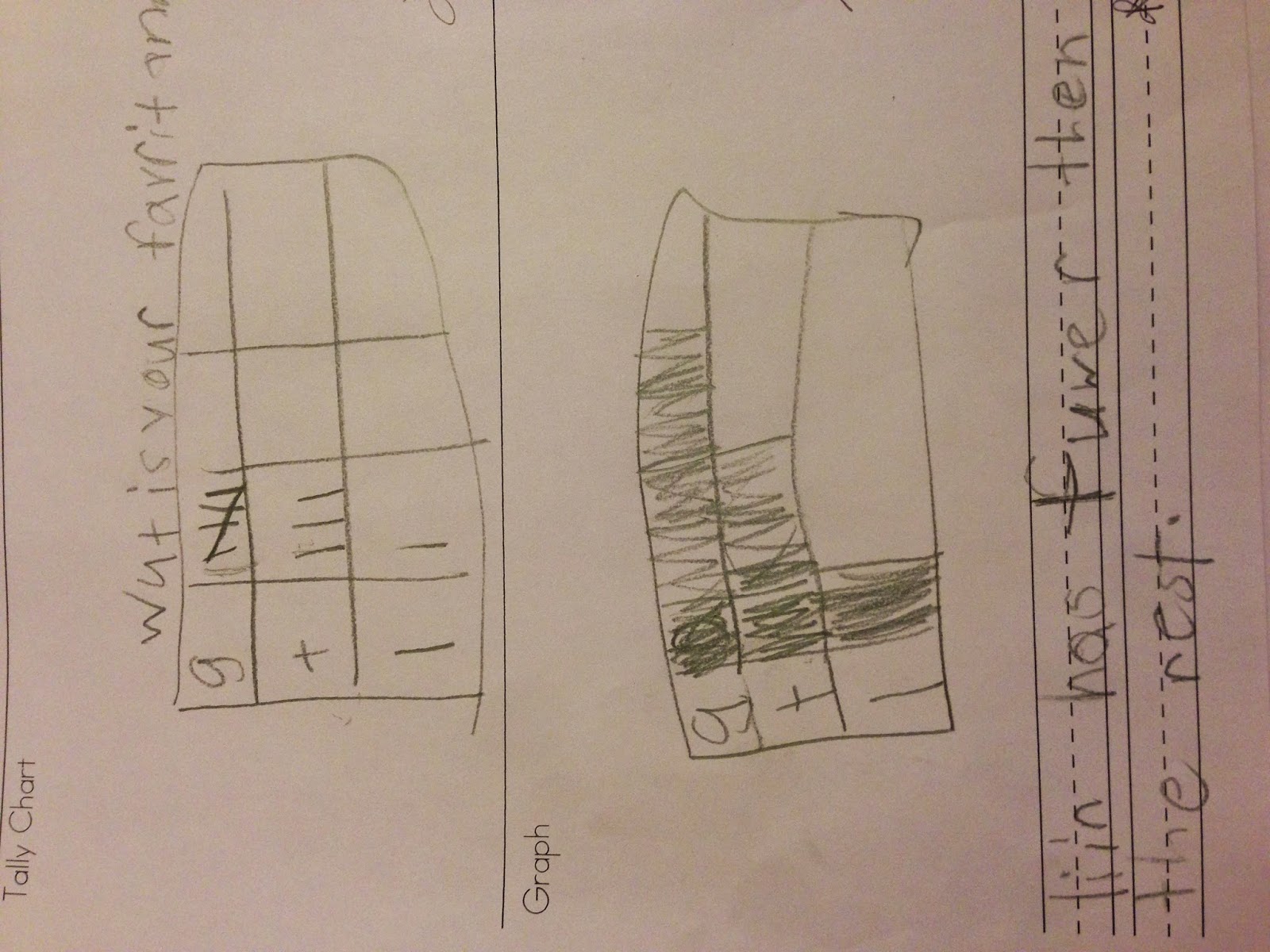
Our assessment always has a "task" component.  The task this time was to write a question, create a tally chart, ask 10 friend, graph the results and then write a sentence about it.  Whew! That's A LOT for a firstie! But they did SOOOOOOOOOOOOOO well! I am one proud math teacher!


What fun things to do you do for graphing??

Happy Friday!!
Sarah